
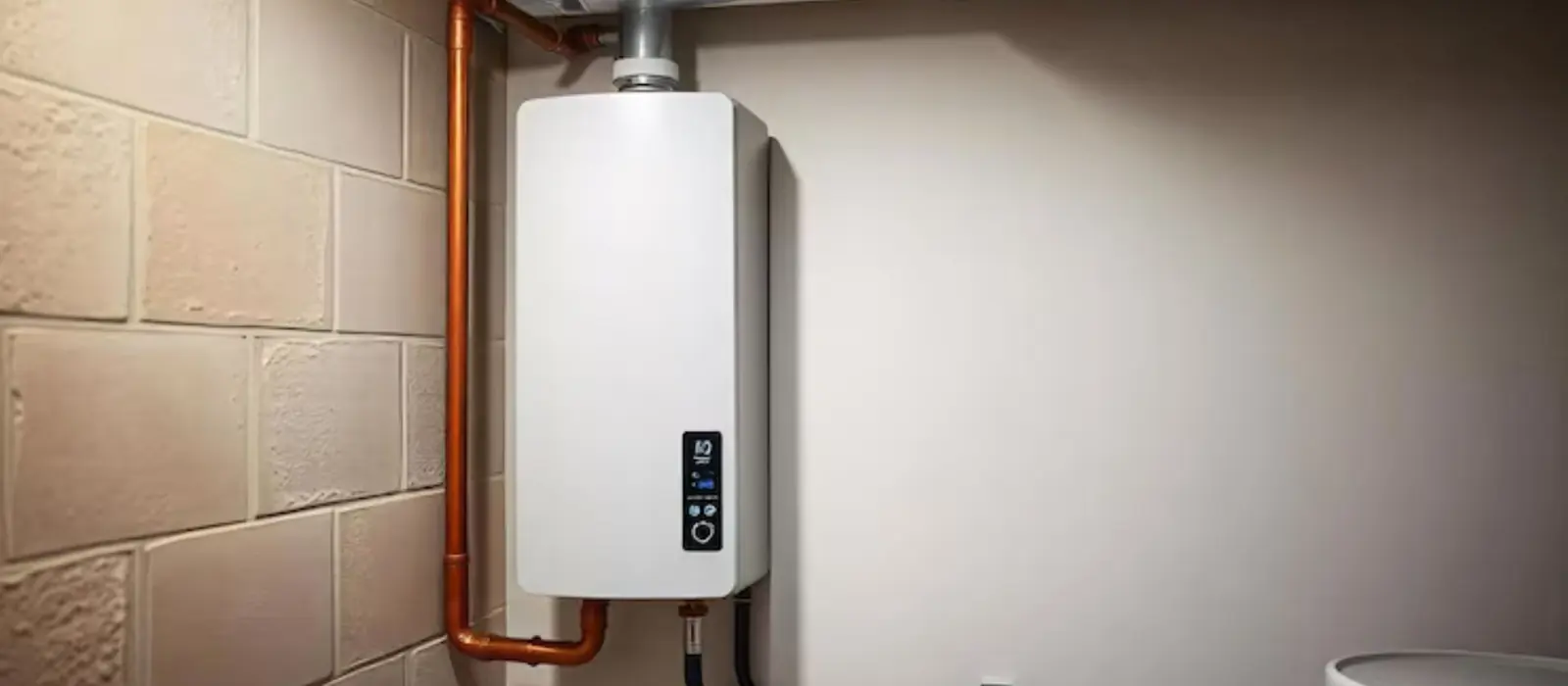
A tankless heater has no storage tank to hide behind. When something fails, you notice it within seconds, usually as water that turns cold halfway through a shower or a display that blinks a number. The good news is that the faults repeat from house to house, so the symptom tells you a lot.
Most units burn gas to heat a copper or stainless heat exchanger as water passes through. A flow sensor tells the control board that water is moving, a flame rod confirms ignition, and a thermistor reads the outlet temperature. If any one of those readings is wrong, the board shuts the burner down to protect the unit.
Which symptom points to which part?
Use this as a starting map. The display code in your owner's manual is more precise than any guess, so read it before you decide anything.
| What you notice | Likely cause | Who handles it |
|---|---|---|
| Hot water fades to lukewarm after a few minutes | Scale narrowing the heat exchanger passages | Homeowner flush, or plumber if it persists |
| Water stays cold at low flow, like a single faucet | Flow too weak to trip the sensor, or a clogged inlet screen | Homeowner can clean the screen |
| Display shows an ignition or flame code | Dirty flame rod, low gas supply, or a failing igniter | Licensed plumber |
| Display shows an exhaust or vent code | Blocked or loose vent pipe, or a bad fan | Licensed plumber |
| Temperature swings between hot and cold | Failing thermistor or a mixing issue with recirculation | Licensed plumber |
Codes vary by brand. Your manual lists the exact meaning for your model.
Tankless unit flashing a code or cutting out mid-shower? Call (855) 575-2890 and describe what the display says.
Call (855) 575-2890What can you check before calling?
Start with the display. Write down the code and the model number printed on the front panel or the data plate on the side. That single detail often lets a plumber bring the right part on the first visit.
Then work through these steps in order. None of them require opening the gas side of the unit.
- Run a hot tap at full flow for a minute and see whether the unit fires at all.
- Check that the gas valve on the supply line is parallel to the pipe, which means open.
- Turn off the cold water isolation valve, unscrew the inlet filter screen, and rinse out any grit or flakes.
- Reopen the valve, bleed air from a hot tap, and power-cycle the unit by unplugging it for 30 seconds.
- Look at the vent termination outside for nests, snow, or a loose joint, without climbing onto a roof.
If the same code returns after the screen is clean and the unit has restarted, stop. Repeated resets can mask a real combustion or sensor problem.
When should you stop and call a plumber?
Some symptoms are about safety, not comfort. Treat these as a reason to stop using the heater.
Stop and call if you notice
- A smell of gas near the unit. Leave the house, avoid switches and flames, call 911 from outside, then call the gas utility.
- Soot, yellow flame, or scorch marks around the cabinet or vent.
- A vent pipe that has separated at a joint or sags away from the unit.
- Water pooling under the heater or dripping from the pressure relief valve.
- Scalding water at the tap even though you set a lower temperature.
Why does scale cause so many repair calls?
Hard water leaves calcium and magnesium deposits wherever it gets hot. Inside a tankless heater the passages are narrow, so a thin layer of scale restricts flow and raises the exchanger's surface temperature. The unit then cuts out on a high-limit code or heats unevenly, which you feel as lukewarm water.
A descaling flush with a small pump and a food-grade acid solution clears most buildup. If the heater was never flushed and has run for years, the scale can be hard enough that the exchanger needs replacing instead. That decision is easier when someone measures the temperature rise and flow rate on site.
What Los Gatos water means for tankless scale
San Jose Water serves Los Gatos, and its 2025 water quality report lists three source types. Mountain surface water averages 151 ppm hardness, groundwater averages 288 ppm, and treated water bought from Valley Water averages 99 ppm.
That spread matters for your heater. Which source feeds your home determines how fast scale builds, so ask San Jose Water or check the report before you pick a flush schedule. A home on the harder groundwater end may need attention sooner than one on Valley Water supply.
The Town of Los Gatos also treats a water heater change differently from a like-for-like swap. Replacing the same type in the same place can use the quick online permit, but a different type or a moved unit needs a regular building permit. If a repair turns into a replacement, ask before you commit to a new location.
Repair or replace a faulty tankless unit?
Repair makes sense when the fault is a single part, such as a flame rod, an inlet screen, a thermistor, or a vent fitting. These parts are cheap relative to the unit, and the heat exchanger is usually still sound.
Replacement starts to win when the exchanger has leaked, when scale has fused across several passages, or when the control board and fan both fail in the same year. A unit that needs repeated visits is costing you in hot showers lost and service calls added.
If you are weighing the two, the plumber we send for tankless water heater service can read the fault history, test gas pressure, and tell you plainly which side of the line you are on. Many faults overlap with ordinary tank problems too, so the water heater repair service covers both types.
Do neighboring towns see the same tankless faults?
The faults are the same everywhere, but the frequency changes with water. Homeowners in Campbell and Saratoga share the San Jose Water service area with Los Gatos, so scale questions follow the same source-by-source logic.
Whichever town you live in, the plan holds. Read the code, clean the inlet screen, and call if gas, flame, or venting is involved. Keep the model number handy so the first call is short.
Tankless repair questions from Los Gatos homeowners
Scale on the heat exchanger and a clogged inlet screen are the two usual causes. Clean the screen first, and if the problem returns, the unit likely needs a descaling flush.
Yes, once or twice. Unplug it for 30 seconds, then restart. If the same code comes back, the unit is telling you something is wrong and repeated resets will not fix it.
Often yes, when one part has failed and the heat exchanger is sound. A leaking exchanger or severe scale across many passages usually points toward replacement instead.
It can. San Jose Water reports different hardness for mountain, groundwater, and Valley Water supplies, so ask which source feeds your home to judge how often to flush.
Our 24/7 dispatch takes calls at any hour. Tell us the brand, the code, and whether you smell gas, and we will work out the next step with you on the phone.