
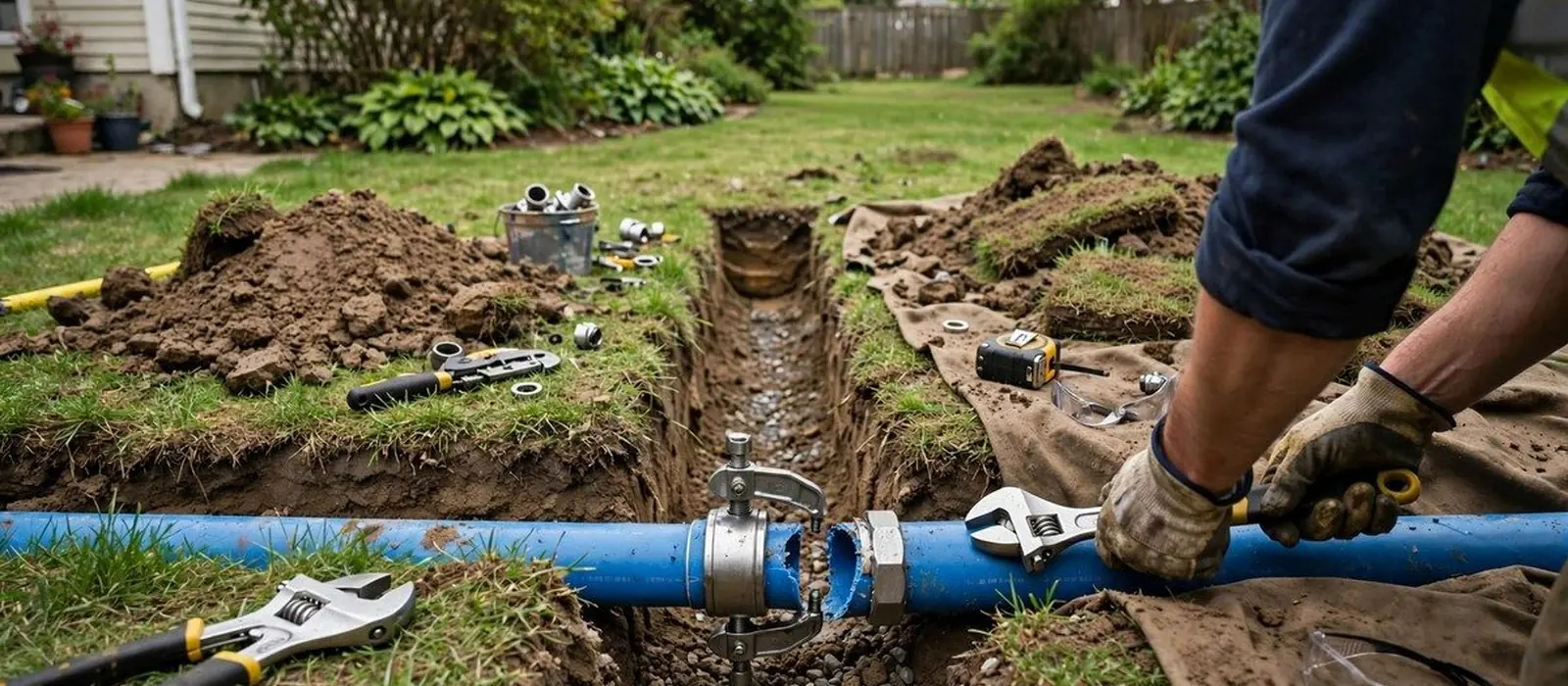
Water line leak: what to do first
If water is surfacing in your yard, pooling at the curb or the pressure has collapsed, we know that cannot wait. Our dispatch line runs 24/7, and you can do a few things while you wait for a plumber.
Water from a service line usually comes from a pipe under pressure, so it keeps moving until someone closes a valve.
- Find the main shutoff valve at the house, often near the hose bib or in the garage, and turn it clockwise until it stops.
- Open the lowest faucet in the house to drain the pipes and relieve pressure, then leave it open.
- Keep people and pets away from any sunken or soft patch of ground, because soil over a leaking pipe can give way.
- Take a photo of the wet area and the meter dial, then call (855) 575-2890.
If the leak is before the shutoff valve, closing the house valve will not stop it. Tell us that on the phone so we plan for the meter-side valve.
Where a water service line fails
The service line is the pipe between the meter box and the point where water enters your home. It is usually buried, and it is usually older than the plumbing inside the walls. Copper, galvanized steel, polyethylene and plastic have all been used, and each fails in its own way.
Galvanized steel rusts from the inside until it narrows and then pinholes. Copper pits where the soil is aggressive. Plastic lines more often fail at fittings, or where a rock or old trench settled against them.
Meter still moving with every tap off? Call (855) 575-2890 and tell us what the dial is doing.
Call (855) 575-2890How to tell the leak is outside the house
Start with the meter. Turn off every fixture, the ice maker and the irrigation controller, then lift the meter box lid and watch the low-flow indicator. If it keeps turning, water is escaping somewhere past the meter.
Next, close your main shutoff valve at the house and look again. A dial that stops points to a leak inside the building. A dial that keeps moving points to the buried line.
Other signs on the ground
- A wet or sunken strip of lawn between the meter and the house, even in dry weather.
- A hissing sound near the main valve at night, when the house is quiet.
Low pressure: the line or the fixtures?
Weak pressure at every tap at once suggests a problem upstream of the branches, which often means the service line or the pressure regulator. Pressure that is low at one faucet only is almost always a clogged aerator or a partly closed angle stop.
Test both. Unscrew the aerator on the kitchen faucet and see if the flow recovers, then open the hose bib closest to the meter. Strong flow there with weak flow inside points to the house piping. A weak hose bib points back to the line, and a hidden leak check can confirm it without digging.
How we locate a buried line leak
Digging blind wastes a day and a lawn. We first confirm the leak with a meter test and a pressure gauge on a hose bib.
To pinpoint the spot we use an acoustic ground microphone, which picks up the hiss of escaping water through soil. Only then do we open the ground, and usually at one small point.
Who handles which part, you or San Jose Water?
San Jose Water serves Los Gatos. It says it has no lead service lines, though it found a small number of lead goosenecks on lines installed before 1946 and is replacing them as it does main replacement work.
That work is the utility's. The pipe on your side of the meter is yours, and it is the part a plumber repairs. If you are unsure where the boundary sits, call the utility about the goosenecks and call us about the leak, so nobody digs in the wrong place.
A trench for a new service line on a steep lot off Highway 17 needs more planning than a flat yard, so expect the plumber to ask about slope and the route from the meter. We repair lines in Santa Clara County ZIP codes 95030, 95031, 95032 and 95033.
Spot repair, new line or trenchless?
A single failed fitting or one pinhole in an otherwise sound pipe is a fair candidate for a spot repair. We cut out the bad section and splice in new pipe, which keeps the trench small.
If the pipe is galvanized and rusting all along its length, a spot repair buys little. The next pinhole is usually nearby. Replacing the whole run with new pipe is the honest answer, and if the rest of the house is also failing, a full repiping job may be worth discussing at the same visit.
Pulling a new line through the old path without a long trench is sometimes possible. We tell you plainly when it is not.
Repair choices at a glance
Use this table as a starting point, then let the leak test and pipe condition decide.
| Situation | Usual approach | Trade-off |
|---|---|---|
| One pinhole, rest of pipe sound | Spot repair with a coupling | Fast, but a second leak can follow if the pipe is aging |
| Rusted galvanized run | Replace the whole run | More digging, but ends repeat visits |
| Pipe under a driveway or patio | Pull a new line or tunnel under | Protects the hardscape, depends on soil and depth |
| Pressure dropped, no wet ground | Test regulator and leak first | Avoids digging for a non-pipe problem |
Permit rules vary, so check with the Town of Los Gatos building division before any trench work.
What shapes the price of a water line repair
Every buried line is different, so the price depends on a few things we can see once we find the leak.
Depth and length
A short, shallow run under lawn is far quicker than a long run under a driveway.
What is on top
Concrete, pavers, landscaping and tree roots all add labor to open and restore the surface.
Pipe material
Copper, PEX and polyethylene differ in material cost and in how they are joined.
Permit and inspection
Some replacements need a permit, which adds a step to the schedule.
On insurance, a sudden accidental discharge is often covered, while wear, corrosion and slow leaks often are not. Policies differ, so read yours or ask your agent before the work starts.
Want your real number? Call (855) 575-2890. We give a clear price before work starts.
Same-day help for a leaking line
A running line wastes water and softens the soil around the pipe, so the sooner it is found, the smaller the hole. We offer same-day appointments when available, and after-hours calls go to our emergency dispatch.
When you call (855) 575-2890, have the meter dial reading, where the water is showing, and whether your main shutoff closed. That lets us bring the right couplings and pipe on the first trip.
Questions about water line leaks in Los Gatos
Yes. Our dispatch runs 24/7, and a surfacing leak or a sudden loss of pressure is treated as urgent. Call (855) 575-2890, close your main valve if you can, and we will line up the next step.
Shut off all water use, lift the meter lid and watch the small low-flow dial. If it keeps turning, water is leaving somewhere past the meter, and a leak-finding visit can find where.
Usually not. We locate the leak first and open the ground at one point where we can. A full-run replacement means a longer trench, and we explain that before we start.
Indirectly. A failing line often loses pressure first, but a sudden break inside is a different job and falls under burst pipe repair.
Yes. The same dispatch covers Monte Sereno and the other nearby towns.