
Slab leak suspected: what to do tonight
A leak under the foundation cannot be seen, but the damage still spreads into flooring, baseboards and the soil beneath the house. Los Gatos Express Plumbing offers 24/7 emergency dispatch, and same-day appointments when available, so a running meter at midnight is a reasonable reason to call.
You do not need to find the leak to slow the loss. The steps below cost nothing and protect the floors while you wait.
- Close every fixture and appliance, then check the water meter. A moving low-flow dial or a spinning triangle means water is leaking somewhere.
- Turn the main shutoff clockwise until it stops, then recheck the meter. If it stops, the leak is on the house side.
- Move rugs and furniture off any warm, damp or buckling floor and switch off power to wet rooms at the breaker panel.
- Leave the main closed overnight if the floor is wet, and call (855) 575-2890 for dispatch.
If the meter keeps turning with the house shutoff closed, the leak may sit between the meter and the house. That points to the buried service line, which we handle separately.
What a slab leak is and why it happens
A slab leak is a leak in a pressurized water line that runs under or through a concrete slab foundation. In many slab homes the hot and cold lines were laid in the soil before the pour, or cast into the concrete, and nobody can see them again until something goes wrong.
The usual causes are plain. Copper pipe can wear through where it rubs the concrete or a gravel edge. Soil that moves, expands or settles puts a bending load on a line.
Corrosion thins older pipe from the outside. Fast water scours elbows from within. Each of these takes years, which is why the first symptom often arrives long after the house was built.
Hear water running when every fixture is off? Call and describe the sound, the warm spot or the meter, and we will plan the visit.
Call (855) 575-2890Warm floors, noises and a jump in the bill
A slab leak shows up as symptoms in the house, not as a visible pipe, so the symptoms are what you can check.
A warm spot on the floor
A hot water line leaking under tile or wood will warm the surface above it, sometimes enough to feel in bare feet. If the spot is directly over where a water heater line leaves the garage wall, tell the dispatcher, because it narrows the search.
Running water sound with everything off
A faint rushing or hissing, loudest on the floor or at a baseboard, is common. Put your ear near the floor in a quiet house and listen near the water heater closet first.
Higher bills and a moving meter
A water bill that jumps with no change in habits, plus a meter that moves with fixtures off, is the clearest signal. Write down the meter reading, wait an hour with all water off, and read it again.
Wet or lifting flooring
Damp carpet at the slab edge, bubbling laminate, cracked grout and a musty smell near baseboards all suggest water is coming up through the slab or along a wall.
How a slab leak is located without guessing
Finding the leak is most of the job. The plumber combines methods because each one has limits.
First comes a meter test, then a pressure test to see whether the hot side, the cold side or both are losing pressure.
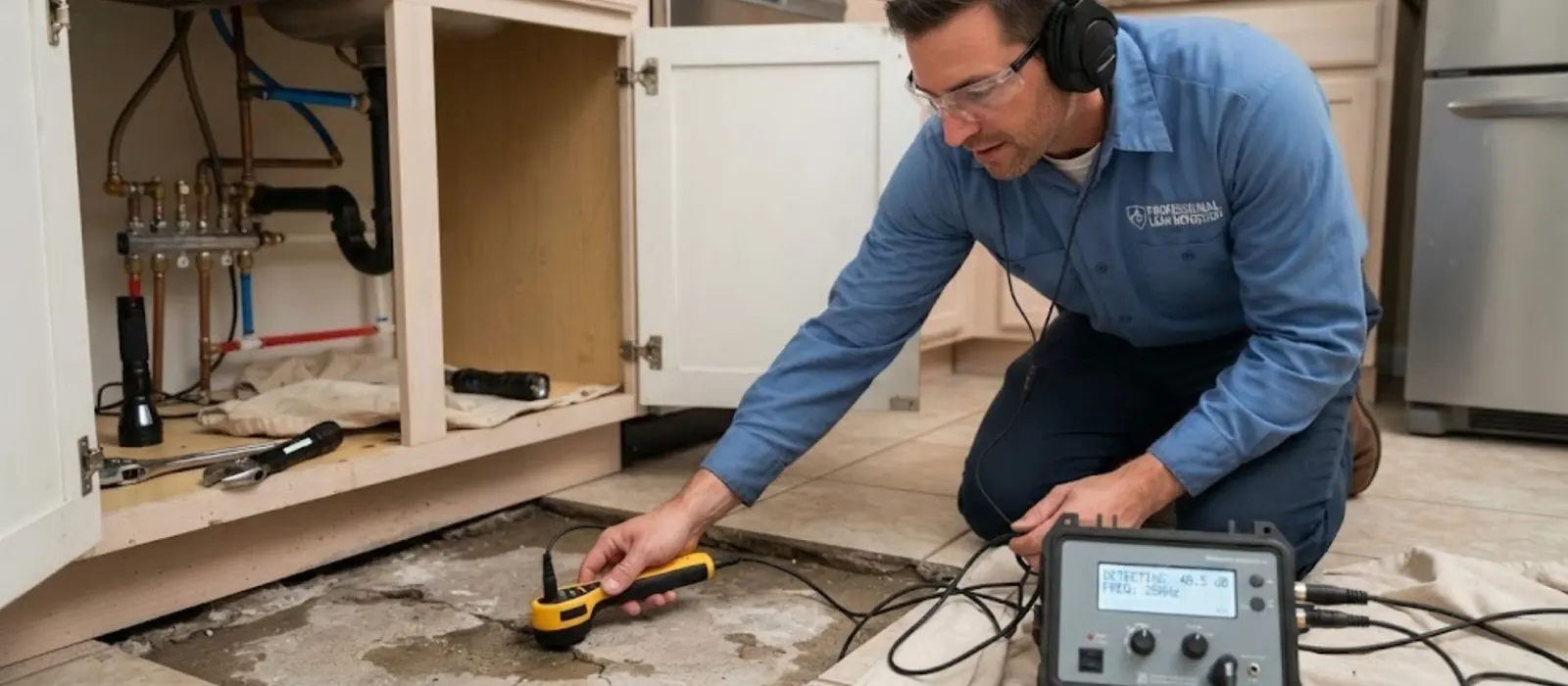
Next, an electronic acoustic listening device is moved across the floor to pick up the sound a leak makes in the pipe. Thermal imaging helps when a hot line is involved, since it can show a warm path. Where needed, tracer gas can be added to the line to find a small leak that is too quiet to hear. We confirm the spot before any cutting so the opening in your floor is as small as it can be.
Spot repair, reroute or repipe
Once the leak is found, there are three real options. Each is right in some houses and wrong in others.
| Option | Best when | Trade-off |
|---|---|---|
| Spot repair through the slab | One leak, sound pipe elsewhere, accessible floor | Breaks concrete and flooring, and nearby pipe stays old |
| Reroute through walls or attic | A leak in a line that is hard to reach, or repeat leaks in one run | New pipe is visible or needs wall openings, but the slab stays intact |
| Whole-house repipe | Several leaks, failing material or a history of repairs | Largest job and largest cost, but fewest future surprises |
| Wait and monitor | Very small loss and no damage yet | Water keeps going into soil, so this is a short-term choice only |
A plumber should explain which option fits your pipe, your floor and your plans for the house.
When a reroute beats cutting the slab
Breaking the slab is a fair choice for a single clean leak, but it is not always the wise one. If the same line has already leaked once, or the pipe is the same age as the rest of the house, a new line overhead can be a better use of money than patching concrete again.
Rerouted lines run through walls, the attic or a soffit. They use new copper or PEX, and the old buried line is capped. The trade-off is patching and painting in the rooms where the new line passes, plus the chance that you will see a pipe where none was visible before. If many lines are suspect, a full repiping job may be the cleaner plan.
Los Gatos water, permits and your decision
Hardness is worth a question if you reroute or repipe. San Jose Water's 2025 report lists mountain supply at 151 ppm, Valley Water treated supply at 99 ppm and groundwater at 288 ppm, and the source that serves your street varies. We cannot say which one you have, so test your tap. If it tests hard, ask about water softener and filtration while the walls are open, since scale builds up inside pipe and on the water heater.
Permit rules vary, so check with the Town of Los Gatos building division before a reroute or repipe. The Town accepts building permit applications through its online portal only, and you should ask who files the permit and whose name goes on it. Ask the plumber to tell you whether your job needs one.
Mountain water from the Los Gatos Creek watershed averages 151 ppm hardness in San Jose Water's report, which is one more thing to mention when the plumber looks at scale or corrosion on an old copper line. We locate slab leaks in Santa Clara County ZIP codes 95030, 95031, 95032 and 95033.
Slab leak or service line leak?
Water between the meter and the house can leak without touching the slab. A wet patch in the yard, a sunken stripe of lawn or low pressure all point outward. The homeowner side of the line is a plumber's job, and water service line repair covers that.
San Jose Water says it found a small number of lead goosenecks on service lines installed before 1946. If your house predates 1946, ask the utility whether your service line is one of them before you plan any work on that line.
If you live in Monte Sereno, the Monte Sereno plumbing page covers the long meter-to-house runs on large parcels, which is where line problems between the meter and the house tend to hide.
What changes the cost of fixing a slab leak
Slab work varies widely from house to house. You get a clear price before work starts, and these are the things that set it.
Detection time
A leak that is loud and shallow takes less time to locate than a quiet one under heavy flooring.
Floor type
Carpet lifts easily. Tile, stone and hardwood cost more to remove and put back.
Option chosen
Spot repair, reroute and repipe differ greatly in materials, labor and wall patching.
Length and number of lines
Hot, cold or both lines may be involved, and some runs are far longer than others.
After-hours work
Night and weekend dispatch is arranged differently from a daytime visit.
On insurance, sudden accidental discharge is often covered, including some resulting water damage. Wear, corrosion and slow leaks often are not. Policies differ, so read yours and report a suspected slab leak promptly.
Want your real number? Call (855) 575-2890. A clear price is given before work starts.
After the repair is finished
Once the repair is complete, keep an eye on the meter for a day. Dry flooring fully before it is replaced, and ask a restoration company about moisture if baseboards were wet. Write down which lines were replaced and where the new route runs so the next owner knows too.
Slab leak questions from Los Gatos homeowners
Yes. Our dispatch runs 24/7 and same-day appointments are offered when available. We do not promise an arrival time, but we can tell you how to confirm the leak and slow the loss while you wait.
A moving meter with the house shutoff closed points outside. A moving meter that stops when the shutoff is closed points inside the house. A warm floor spot or a running sound under the floor suggests the slab.
Not always. Spot repair means opening the floor and slab, but a reroute through walls or the attic can leave the slab alone. We explain both before work starts.
Sudden accidental discharge is often covered. Gradual corrosion and wear often are not. Policies differ, so check yours before the repair.
Check the meter first. If it moves with every fixture off, water is escaping somewhere, and under a slab it keeps soaking soil and flooring. Close the main when you are away, write down the reading and book a visit soon rather than waiting.
Both. We use pressure testing, acoustic listening and thermal imaging, and can pair with a separate leak search when the source is unclear.