
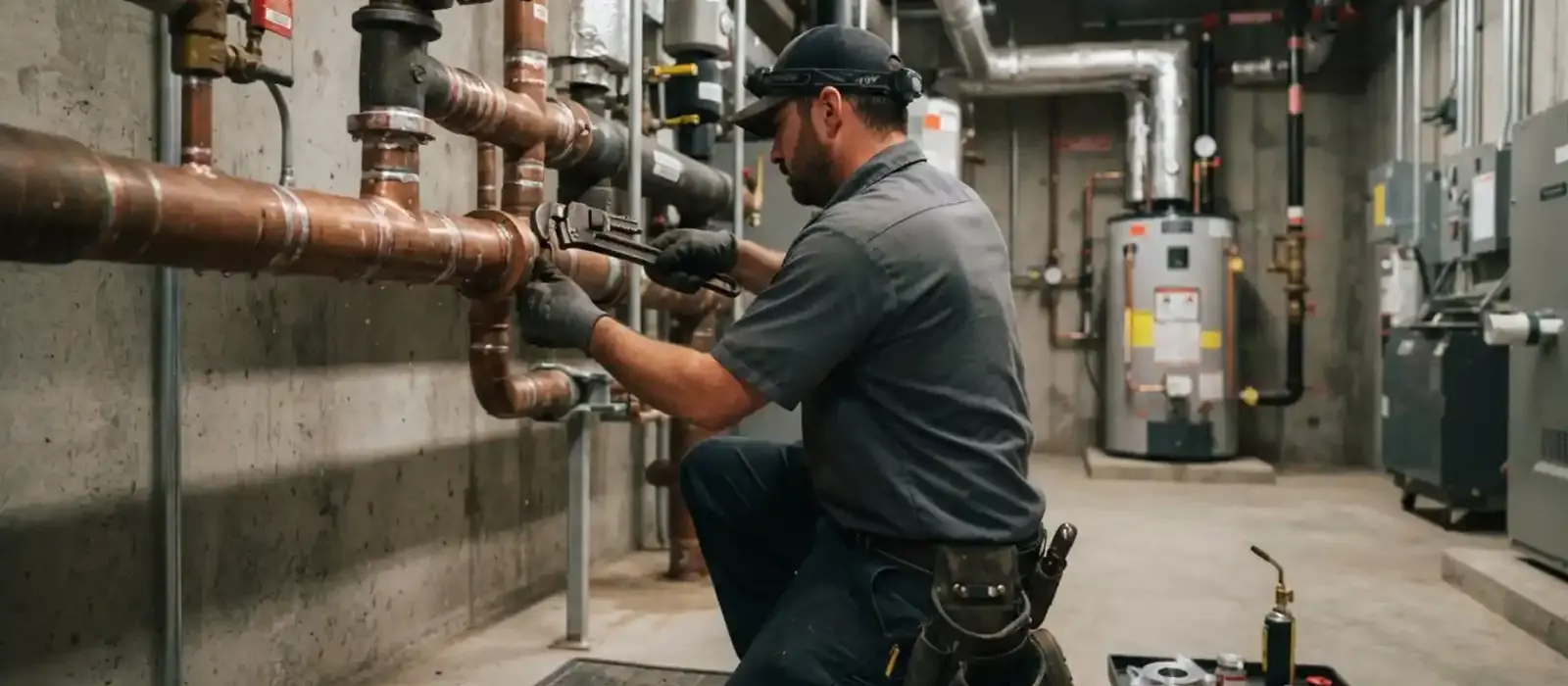
Commercial plumbing emergency: what to do first
A flooding restroom or a backed-up kitchen drain is costing you customers while it runs, and we answer that kind of call 24/7. Before we arrive, a few quick moves limit the damage and tell us what we are walking into.
Everyone in the building should stay out of standing water near outlets or equipment.
- Close the building's main water valve, usually near the meter box or on the wall where the supply enters, by turning it clockwise.
- Switch off power to wet areas at the panel, and unplug floor-level equipment if you can do so dry.
- Move stock, paper and electronics off the floor, and stop using every restroom and sink on the affected drain line.
- Call (855) 575-2890 and tell us the building type, the floor, and whether the water is clean, gray or sewage.
If you are a tenant, call your property manager too. Some leases decide who may order emergency work, and we would rather know before we start.
How commercial plumbing differs from a house call
A commercial building has bigger pipe, more fixtures on one line and a lot of people sharing them. A stoppage in a ten-fixture restroom group behaves nothing like a single bathroom sink. Flow rates are higher, so a failed valve empties more water onto the floor, faster.
Retail units often share a roof, a main line or a cleanout with neighbors. Offices may have a mechanical room with a water heater, a booster pump or a tempering valve. Restaurants add floor drains, prep sinks, dishwashers and grease interceptors to that list.
If your shop or office sits near Highway 17, tell the dispatcher the nearest cross street and which door the plumber should use, since a jetter or camera cart needs a clear path. Commercial calls from Santa Clara County ZIP codes 95030, 95031, 95032 and 95033 go through the same line.
Water on the floor of the shop tonight? Call (855) 575-2890 and tell us the building type and where the water is coming from.
Call (855) 575-2890Restaurant drains, grease and the district rule
Kitchen drains clog from grease, starch and food solids that cool and harden in the line. The cable we use first clears a stoppage, but repeat clogs usually mean grease has built up on the pipe wall, and high-pressure jetting scours it clean.
West Valley Sanitation District requires food service establishments connected to its sewer to have a grease control device approved by the district manager, and it does not allow chemical or bacteria injection ports on grease traps. Ask the district before you add or change a trap, and keep the pumping schedule written down.
Backflow testing and protection for businesses
A backflow assembly keeps used or contaminated water from flowing back into the clean supply when pressure drops. Businesses commonly have one on the water line, on a fire sprinkler feed, on an irrigation system or on a boiler fill.
These devices have springs, check valves and test cocks that wear or foul with debris. Testing confirms each part still seals. Which devices need testing and how often is set by the water supplier and local rules, so ask San Jose Water or the Town what applies to your building, then call us to schedule the test or repair a failed assembly.
Sewer backflow devices in low buildings
The sanitary district can require an owner-funded sewer backflow device when the lowest fixture floor sits less than a foot above the nearest upstream manhole, or when past backups call for one. Owners are told to check it every three to six months, because its flap can close during a blockage.
If your restroom or floor drain overflows during heavy use, that device is one of the first places to look. We check the flap, clean the housing and clear the line downstream.
Commercial leak detection, honestly
Some commercial water losses are traceable, and some are not worth the chase. Meter readings after hours, listening on exposed pipe and pressure tests can find a hidden supply leak in a slab or ceiling.
If the loss is small and the water bill is the only symptom, check irrigation timers and toilet flappers first. Our leak-finding method is the same one used in homes, and we will tell you if the test shows no leak to find.
Which problem needs which approach
A quick map of common commercial calls and the first thing we usually do.
| Problem | First step | Possible next step |
|---|---|---|
| Restroom stoppage after closing | Cable the line from a cleanout | Camera check if it returns |
| Kitchen floor drain overflow | Clear the drain and trap arm | Jet the line, review the grease trap |
| Water heater leak in a mechanical room | Isolate and drain the tank | Repair or replace the unit |
| Failed backflow test | Rebuild or replace the assembly | Retest and send the report |
| Wet ceiling tile below a restroom | Open the access, find the source | Repair the supply or drain above |
Permit rules vary, so check with the Town of Los Gatos building division for larger work.
Working inside an occupied building
We plan the job around your hours. That can mean working before opening, after closing or through a night call. We lay drop cloths, block off the work area and keep water shut off to the smallest zone we can.
Property managers can tell us who to call for access, and we ask that anyone ordering the work confirm they are allowed to. Commercial calls in neighboring Campbell go through the same dispatch.
What affects the price of a commercial plumbing job
Business jobs vary widely, so the price follows the scope we find.
Hour of the call
Late-night and weekend visits need extra staffing, which changes the labor line.
Pipe size and access
Larger lines and tight ceilings or crawl spaces take longer to reach and repair.
Equipment needed
A cable machine, a jetter and a camera are different tools with different run times.
Parts and assemblies
Valves, backflow parts and fixtures vary by size and rating.
Tenant and owner coordination
Waiting on approvals, keys or shutdown windows adds time on site.
Business insurance often covers sudden, accidental water damage but may not cover wear, corrosion or slow leaks. Policies differ, so check yours or call your broker.
Want your real number? Call (855) 575-2890. We give a clear price before work starts.
A same-day plan for your next problem
Same-day appointments are available when the schedule allows, and urgent calls go to emergency dispatch at any hour. For planned work, such as a backflow test or a fixture swap, call during the week and we will fit it around your hours.
Keep a short list near the front desk with the main shutoff location, the nearest cleanout and your property manager's number, so any staff member can help the moment trouble starts.
Commercial plumbing questions from Los Gatos businesses
Yes. Our dispatch runs 24/7 and takes after-hours calls for shops, offices and restaurants. We do not promise an arrival time, but we will tell you what to shut off while you wait.
Yes. We clear the stoppage with a cable or a jetter, and check whether the grease control device needs pumping, which is a separate job.
We service and test them, and repair or replace assemblies that fail. Ask your water supplier or the Town which devices at your building need testing.
Call the property manager if your lease says so, and call us right after if water is flowing. We can start mitigation steps once someone authorized agrees.
Often, yes, with an after-hours meter check, acoustic listening and pressure tests. See our leak detection page for how that works.
Yes. We cable and jet from the cleanout, and a camera shows the cause if the line keeps backing up. See how a main line is cleared for the method.