
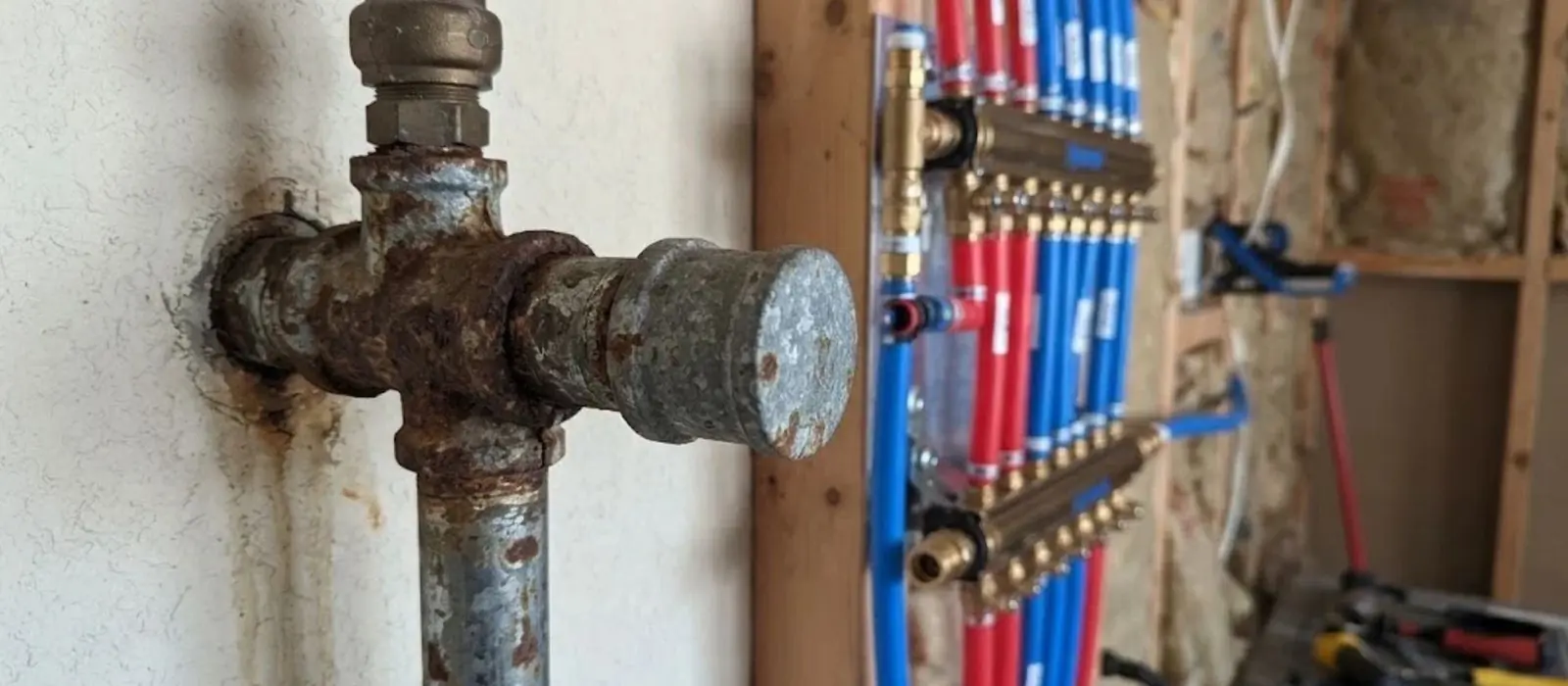
What a repipe replaces inside your house
A repipe replaces the water supply pipes that run from your main shutoff to every faucet, toilet, appliance and water heater. It does not touch drain lines, which carry waste away by gravity. Most jobs swap galvanized steel, aging copper or failing polybutylene for new PEX or copper.
The scope can be the whole house or only part of it. A partial job might renew the kitchen and hall bath branch while a healthy copper trunk line stays in place. The right scope depends on what the pipe looks like inside, not only on the leak you can see.
Pinhole leaks, brown water and weak pressure
Supply pipes rarely fail all at once. They warn you first, and the warnings are easy to dismiss.
- Green or white crust on copper, or beads of moisture at a fitting, where a pinhole may be weeping.
- Brown or rusty water from a cold tap that clears after a minute of running.
- Pressure that has dropped at several fixtures while the outdoor hose bib still runs strong.
- Repeated patches in different spots on the same line, which suggests the pipe wall is thin everywhere.
- A damp stain on a ceiling or a soft patch of wall near a pipe run.
Galvanized steel corrodes from the inside, so the opening narrows long before it leaks. That is why weak pressure often shows up first. If only one fixture is weak, unscrew its aerator, rinse out the grit and test again before blaming the pipes.
When the whole house is weak, check the meter. If pressure falls only when the meter is involved, the buried line may be the culprit, and that work falls under water service line repair rather than a repipe.
Want a repipe walk-through scheduled? Call (855) 575-2890 and describe where the pipes are leaking or losing pressure.
Call (855) 575-2890Does Los Gatos water change the plan?
San Jose Water serves Los Gatos from three source types, and they differ in hardness. Its 2025 report gives about 151 ppm for mountain surface water, 288 ppm for groundwater and 99 ppm for treated Valley Water supply. Which source reaches your street varies, so test your tap instead of guessing.
Harder water leaves more mineral scale inside old pipes, fittings and aerators. Ask to see a cut section of the old line during the walk-through. It shows whether the narrowing is scale, rust or both, and that tells you how much flow a new pipe will give back.
San Jose Water also advises running a tap for 30 seconds to 2 minutes after water has sat for hours. Do that before judging color. Water that stays brown after two minutes points to the pipe itself rather than the main.
Mountain surface water from the Los Gatos Creek watershed is one of the supplies San Jose Water lists, and its hardness differs from groundwater, so test your tap before you choose between a new line and a softener. Repipes across Santa Clara County in ZIP codes 95030, 95031, 95032 and 95033 are quoted from this number.
Repair one leak or replace the whole run?
A single pinhole in otherwise sound copper is a repair. Cut out the bad section, sweat in a coupling and you are done. The math changes when a second or third leak appears within a short time. Each patch costs wall access and a shutoff day, and the next failure is usually close by.
Galvanized steel is a different story. Its failure is internal and widespread, and threaded joints on old steel often crack when a wrench turns them. If your house still has galvanized supply lines, plan a replacement rather than a series of patches.
If a pipe is spraying right now, close the main shutoff and call for burst pipe repair first. Plan the repipe after the water is off and the house is dry.
PEX, copper or CPVC for the new lines
The choice depends on budget, wall access and how the house is framed. Ask your plumber to explain why a material suits your layout.
| Material | Strengths | Trade-offs |
|---|---|---|
| PEX | Flexible tubing, fewer joints, easy runs from a central manifold, no internal rusting. | Needs proper supports and protection from sunlight. Fittings are crimped or clamped, so quality of the tool and ring matters. |
| Copper | Long record in homes, rigid and neat, handles heat well. | More soldered joints and more labor. Hard water and aggressive water can pit it over time. |
| CPVC | Rigid plastic, lower material cost, no soldering. | Can turn brittle with age and heat. Less common for whole-house work, so ask about local acceptance. |
Local building rules decide what is accepted, so confirm the material with the Town of Los Gatos building division.
How a repipe goes, room by room
The job starts with a walk-through. We trace the main shutoff, the line to the water heater and each fixture group, then decide where to open walls. A manifold, a central fitting with a shutoff for each branch, usually goes near the water heater or in a garage wall. PEX then runs home to each bathroom, the kitchen and the laundry.
Access holes are cut in drywall, often in closets, behind vanities and in the garage. Old lines are capped or removed and new lines are pressure tested before anything is closed. The holes are patched, but painting is a separate trade, so plan for it.
The water is off for part of each workday. Fill a few containers, run laundry the day before and decide where everyone will shower.
Permits and checking who does the work
Permit rules vary, so check with the Town of Los Gatos building division before work starts. The Town accepts building permit applications only through its online citizen portal, and you must register an account first. Ask who files the permit and whose name goes on it.
That makes a license check worthwhile. The Contractors State License Board has a License Check tool on its website, and it takes a few minutes. Ask your contractor who pulls the permit and who books the inspection, and get the answer before the first wall opens.
What shapes the price of a repipe
No two houses price the same. These are the factors that move the number most.
Fixtures and bathrooms
More fixtures mean more branches, more fittings and more wall openings.
Pipe material
PEX, copper and CPVC differ in material cost and in the labor each one needs.
Access
Open crawlspaces and attics are quick. Finished walls, tile and two-story runs take longer.
Patching and finish work
Drywall repair, paint and any texture matching add to the total or fall to a separate trade.
Scope
A partial repipe of the worst branches costs less than a whole-house job but leaves older pipe behind.
On insurance, a sudden burst or accidental discharge is often covered, while wear, corrosion and slow leaks often are not. Policies differ, so read yours or ask your agent before assuming either way.
Want your real number? Call (855) 575-2890. We give a clear price before work starts.
Booking the walk-through
Before you call, note which fixtures are weak, where you have seen stains, and what the pipes under the sinks are made of. Photos of the main shutoff and the water heater connections help. We schedule planned repipes across the area, including Saratoga homes through our Saratoga service area, and same-day appointments are available when the schedule allows.
Call (855) 575-2890, describe what you see, and we will set up a walk-through.
Questions homeowners ask before a repipe
Not always. One pinhole in sound copper is usually a repair. Several leaks in a short time, or any leak in galvanized steel, points toward replacing the run.
Some drywall openings are normal, mostly in closets, garages and behind fixtures. They are patched afterward, and painting is separate.
Usually yes, but the water is off for part of each workday. Plan bathroom and laundry use around it.
It fixes pressure lost to narrowed or corroded supply pipe. If the loss starts at the meter or street, the buried line needs attention instead.
Galvanized is gray and magnetic. Copper is orange-brown and not magnetic. Plastic PEX is often red, blue or white. A plumber can confirm at the main shutoff.
Yes. A hidden leak check can locate a hidden leak with acoustic and pressure methods, which sometimes limits the work to one branch.