
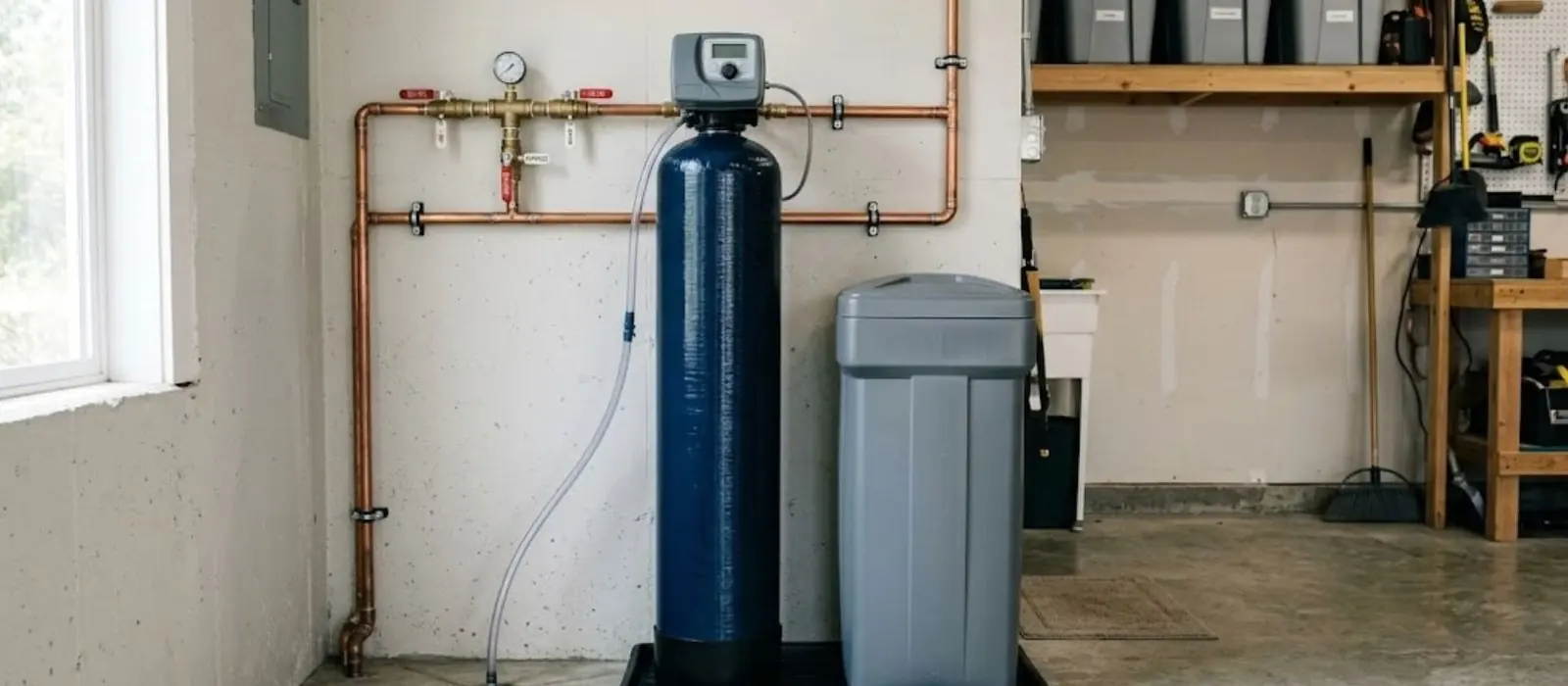
What softeners and filters actually do
A softener is a resin tank that swaps hardness minerals for sodium or potassium, then flushes itself with brine on a schedule. A filter is different. Carbon cartridges reduce chlorine taste, sediment filters catch grit, and reverse osmosis units polish drinking water at one tap.
Many homes need only one of these, and some benefit from two. Starting with the symptom helps you avoid buying the wrong tank.
How hard is the water at your Los Gatos tap?
San Jose Water's 2025 report lists three source types. Mountain surface water averages 151 ppm hardness, which is 9 grains per gallon. Groundwater averages 288 ppm, or 16.8 grains per gallon, with results from 175 to 451 ppm. Treated Valley Water supply averages 99 ppm, or 5.8 grains per gallon.
Which source serves a given home varies, so test your tap. A home test strip or a lab test gives a number to size against. A softener sized for 6 grains will run out of capacity quickly on 16 grains, and regenerations will come more often than you expect.
Homes on wells in the mountains above Los Gatos, near Lexington Reservoir, face county groundwater that Valley Water says averages over 250 mg/L hardness, so a water test comes before a softener. We service Santa Clara County ZIP codes 95030, 95031, 95032 and 95033.
Ready to size a softener or filter? Call (855) 575-2890 and tell us about spotting, scale and how many people use the water.
Call (855) 575-2890Spots, crust and short-lived appliances
Hardness shows up in small ways before it costs real money.
- White spots on glasses and shower doors that return a day after cleaning.
- Crusty buildup around faucet spouts and inside aerators.
- Soap that lathers poorly and leaves a film on skin or tile.
- A kettle or coffee maker that scales up quickly.
- A water heater that rumbles from sediment, or a tankless unit that throws scale warnings.
San Jose Water suggests cleaning aerators regularly, which is a good first test. Soak one in vinegar and see how much mineral comes off. If it is heavy, a softener will cut the cleaning chore. For heaters, scale insulates the heating surface, which is why our guide to tankless water heater service stresses flushing.
Do you also need to treat chloramine?
San Jose Water says chloramine and chlorine may be present in its water. The report lists total chlorine at a running annual average of 1.42 ppm against a limit of 4.0 ppm as Cl2. That is within the limit, so a filter here is about taste and personal choice rather than compliance.
A softener does not remove chloramine. A catalytic carbon block can reduce it, though contact time and cartridge size matter. The utility also notes that aquarium owners and home dialysis users must remove or account for the disinfectant, so tell your plumber if either applies to you.
Softener, conditioner, carbon or RO?
Each option treats a different problem. Match the tool to the symptom you want gone.
| Option | Treats | Does not treat | Upkeep |
|---|---|---|---|
| Salt or potassium softener | Hardness minerals, scale, soap film | Chloramine, most taste issues | Refill salt, service the valve and resin |
| Salt-free conditioner | Changes how scale forms and sticks | Does not remove minerals, so results vary | Replace media on schedule |
| Whole-house carbon filter | Chlorine taste and odor | Hardness | Replace the cartridge or media |
| Under-sink reverse osmosis | Drinking and cooking water at one tap | Whole-house scale | Replace filters and membrane |
Softened water adds a small amount of sodium, so ask about potassium and about a separate drinking tap.
Where the system goes and what it connects to
Most softeners go in a garage or side utility space, tied into the main line after any hose bib you want left hard. A bypass valve lets you isolate the tank for service. The unit also needs a drain connection with a visible air gap and a nearby outlet.
Settle where regeneration water drains before anything is delivered. A softener left without a proper drain path is a common source of leaks. Replacing a water softener with the same type in the same location needs a Town of Los Gatos permit that can be applied for online, so ask who files it.
Salt, resin and the valve that fails first
Brine tanks need salt topped up before the pellets drop to the bottom. A hard crust can form on top of the salt and leave a hollow beneath, so poke it with a broom handle if the unit stops softening. That is called bridging, and it is an easy fix.
When softening fades, the cause is usually the control valve, a clogged injector or worn resin. A valve replacement is cheaper than a new tank, and a conditioner repair visit can tell you which part has failed. If the heater was drained or flushed recently, mention it, since scale loosened by the flush can clog small screens.
What affects softener and filter pricing
Prices vary because the equipment, the plumbing changes and the hardness all differ.
Measured hardness
Higher grains per gallon call for more resin and a larger tank.
Household size
More people use more water, so regeneration cycles come more often.
Type of system
A softener, a whole-house filter and an under-sink unit have different costs.
Plumbing changes
Unions, bypass valves, an air gap and a drain tie-in add labor.
Permit and electrical
A same-location swap has one permit path. A new location may need more.
On insurance, a leak caused by a sudden failed connection may be covered, while wear and slow seepage often are not. Policies differ, so check yours.
Want your real number? Call (855) 575-2890. We give a clear price before work starts.
Planning your visit
Bring a test result if you have one, or tell us the symptoms. Note whether a softener already exists, its age and where it sits. We serve south San Jose homes too, and our Cambrian Park service area page lists the coverage. Same-day appointments are available when the schedule allows.
If you are also adding a new water heater, see water heater installation so both jobs can be planned at once. Call (855) 575-2890 to start.
Softener and filter questions answered
It varies, and we cannot state it by street. Test your tap, or ask San Jose Water which source serves your area.
No. Softeners treat hardness. A carbon filter is the usual tool for chlorine taste and can reduce chloramine.
It depends on hardness, household size and tank capacity. Harder water means more frequent cycles.
Often yes. Control valves, injectors and brine lines can be replaced without replacing the tank.
The Town requires a permit to replace a softener with the same type in the same location, and it can be applied for online. Other changes follow the regular building path.
Less scale generally means less sediment and easier flushing. See water heater installation for how placement and permits work.