
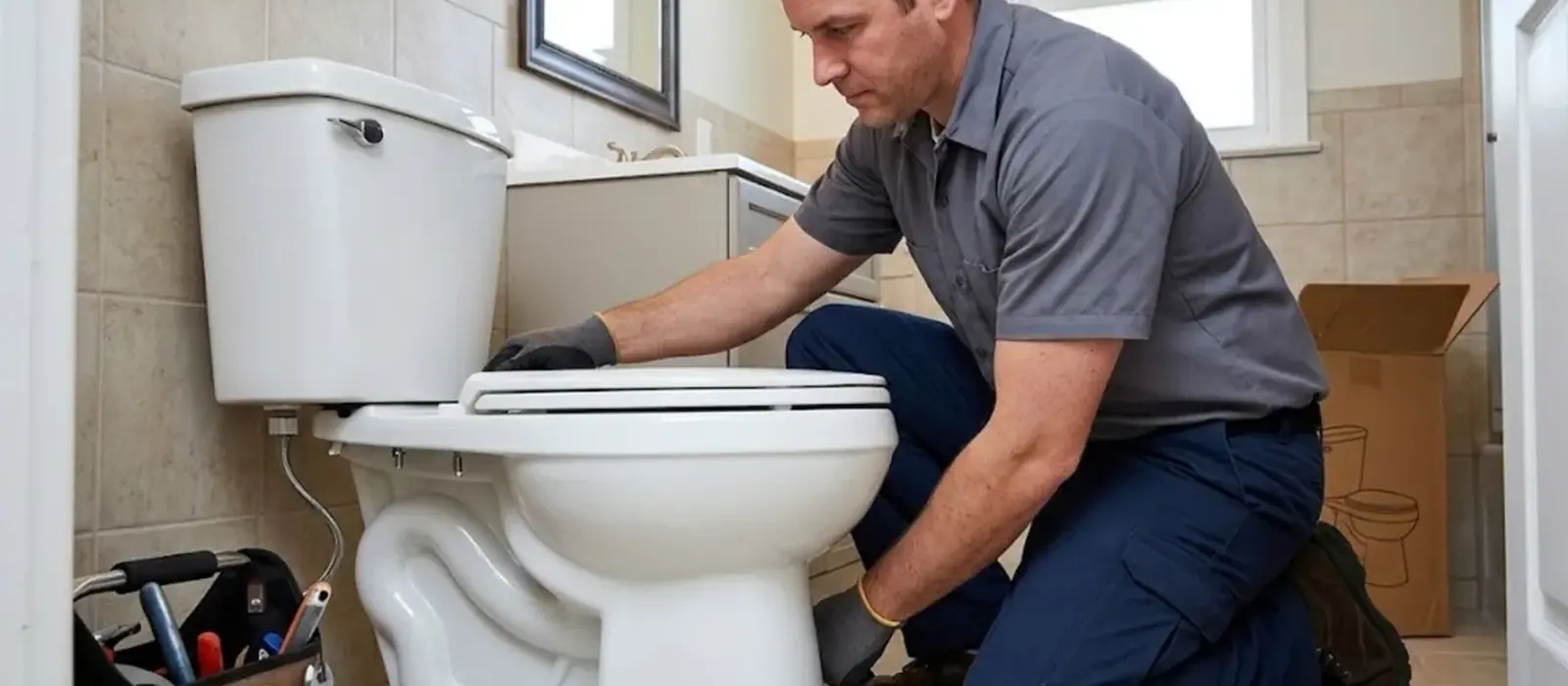
Toilet paper is made to break apart in water, so a normal amount rarely stops a healthy toilet. Trouble starts when the paper arrives in a lump, when the sheets are thick or quilted, or when the toilet itself no longer pushes water hard enough to carry the load through the trapway.
That is why two households flushing the same brand can have opposite results. The paper is only half the story. The other half is the flush, the trap and the pipe the waste enters next.
Why does toilet paper clog some toilets and not others?
A toilet moves waste through an S-shaped trapway just behind the bowl, typically about two inches wide. A strong siphon pulls everything through in one go. A weak one leaves paper hanging in the bend, where it packs down and catches the next flush.
Several things weaken the flush. Mineral scale can block the rim jets under the bowl lip. A flapper that closes too early shortens the water release.
A low water level in the tank sends less volume. Older low-flow toilets also depend on a clean trapway to work at all.
Then there is the paper. Multi-ply and quilted rolls hold together longer, so a long strip can ball up before it breaks down. Flushing half a roll at once almost guarantees a stall.
Toilet clogging again after you plunged it? Call (855) 575-2890 and tell us if other drains gurgle too.
Call (855) 575-2890Is it the paper, the toilet or the pipe?
Where the symptoms show up tells you where the clog sits. Use this table before you grab any tool.
| What you notice | Likely location | Next step |
|---|---|---|
| Bowl fills slowly, drains after a minute, only this toilet | Trapway or paper wad in this toilet | Plunge with a flange plunger |
| Weak swirl and the bowl never quite clears, even without paper | Scaled rim jets or a short flush | Check the flapper and clean the jets |
| Toilet and tub both gurgle or back up | Branch drain for the bathroom | Stop using water and call for drain cleaning |
| Every drain in the house is slow, or a floor drain bubbles | Main line or lateral | Stop using water and call |
| Clog returns within days after plunging | Partial blockage deeper in the line | Have the line cabled or camera inspected |
One fixture suggests a local clog. Several fixtures suggest the shared drain.
How to clear a paper clog the right way
Start with a flange plunger, the type with a rubber sleeve that folds out from the cup. A flat cup plunger seals poorly on a toilet. Make sure the bowl holds enough water to cover the cup, and add a little from a bucket if needed.
- Seat the plunger over the drain opening so the flange sits inside the hole.
- Push down slowly once to push out the air, then pull up sharply.
- Work in 10 to 15 firm strokes, keeping the seal.
- If the water drops and swirls, flush once while ready to lift the lid and close the flapper if the bowl rises.
- If nothing moves after a few rounds, stop and try a closet auger.
A closet auger has a curved shaft that protects the porcelain. Feed it into the trapway, crank until you feel resistance break, then pull it back. Skip drain chemicals. They can sit in the bowl, splash on skin, and make the next person working on the pipe unsafe.
When to stop and call a plumber
Some clogs are not worth fighting. Stop and call if any of these show up.
Stop and call checklist
- Water rises in the toilet when you run the shower, washer or a sink.
- A bathtub or floor drain gurgles, bubbles or backs up after you flush.
- The bowl nears the rim and you cannot stop the flow. Turn the shutoff valve behind the toilet clockwise to close it.
- You see raw sewage on the floor. Keep children and pets out, and avoid touching it without gloves.
- You have plunged twice and the clog returns within a day or two.
- A child's toy or other hard item may be lodged in the trap.
Wipes are the bigger problem than paper
Paper breaks down. Wipes do not, even when the package says flushable. They hold their shape, snag on rough pipe joints and tree roots, and wind together into a rope that no plunger will pull free.
The usual place wipes stop is the first bend or joint outside the house. That is why a family can flush nothing but paper at the toilet and still find the line blocked, because the wipes arrived from another bathroom upstream.
What Los Gatos sewer rules say to flush
West Valley Sanitation District serves Los Gatos, Campbell and Monte Sereno, and its public message is simple. Flush only toilet paper, pee and poop. It also says to keep so called flushable wipes out of the toilet. Treat those wipes as trash and keep a small lidded bin in each bathroom.
If sewage backs up, the district tells residents to call it first and stop using water until the line clears, and there is no extra charge for the crew visit. District crews check the main and, if there is a cleanout, clear the lateral between that cleanout and the main. Anything beyond that is a plumber's job.
The upper lateral from your house to the property line cleanout is the owner's responsibility. If your home has no cleanout, or you do not know where it is, the district says the owner is responsible for clearing the line to the main. Locate your cleanout before a backup so you can tell the district where it is. If you have a sewer backflow device, check it every three to six months, since its flap can close during a blockage.
What a plumber does when the clog is in the line
For a clog beyond the toilet, a plumber runs a motorized cable through the branch drain or the cleanout to break the blockage. A drain cleaning visit starts there for a repeat toilet clog, and the plumber can confirm the pipe is clear by running water afterward.
When the problem sits in the main run, clearing the main line with a larger cable or a hydro jet clears grease, paper and wipes from the pipe wall. A camera inspection afterward shows if there is a belly, a cracked joint or roots, which tells you whether the clog will come back.
We dispatch to Cambrian Park and Campbell as well as Los Gatos, so call (855) 575-2890 if a toilet backs up at night. We dispatch 24/7, and a clear price is given before work starts.
Ways to keep paper from clogging again
Flush in smaller batches. If you have used a lot of paper, flush twice. Switch to a single-ply or septic-safe roll if your toilet is a low-flow model that struggles. Clean the rim jets with a small brush and white vinegar if the swirl looks weak.
Check the flapper once a year. If it leaks, the tank refills constantly, and if it closes too soon, the flush loses force. Replacing it is a small job, and it brings back a stronger flush.
Toilet clog questions from Los Gatos homes
There is no fixed count, but a handful of sheets at a time is safe for most toilets. If you used a lot, flush twice instead of once.
No. West Valley Sanitation District says to flush only toilet paper, pee and poop and not to flush so called flushable wipes. If a toilet keeps clogging, the line may need a plumber.
A flange plunger used with steady strokes will not harm porcelain. Avoid metal tools in the bowl, and use a closet auger instead.
A partial blockage in the branch drain or a scaled trapway is the usual cause. Plunging clears the symptom but not the source, so a cable or camera check is the next step.
We advise against it. Chemicals can sit in the bowl and splash, and they leave the next person at risk if the clog needs a hands-on fix.
Yes. Our dispatch runs 24/7, and we give a clear price before work starts. Call (855) 575-2890, shut off the toilet's supply valve and stop using water while you wait.