
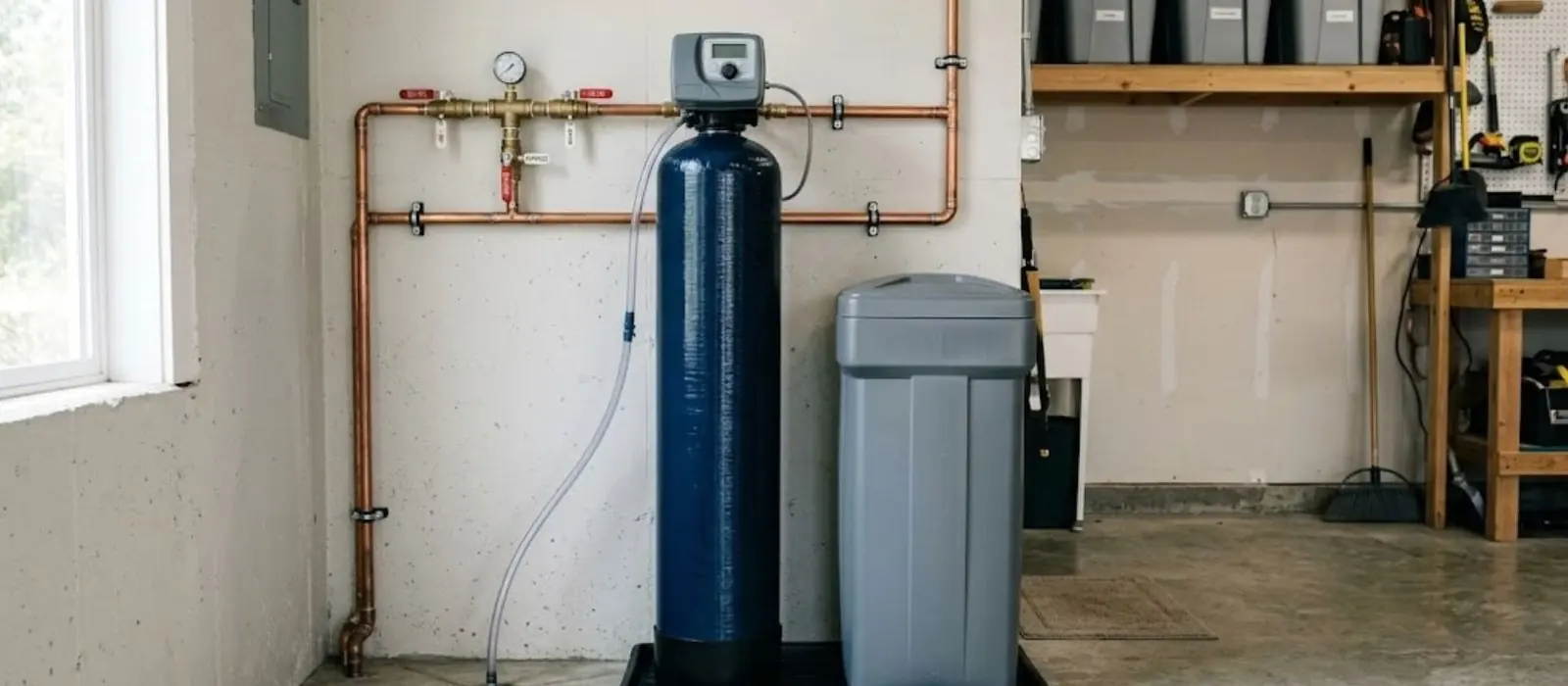
Softener salt looks like a simple purchase, yet the wrong bag can cause a clogged brine tank and hard water at the tap. Salt recharges the resin beads that pull calcium and magnesium out of your water. If the salt cannot dissolve or sits on a crust, the resin never gets a full recharge.
The right choice depends on your softener model, how much salt it holds and how hard your water is. The sections below cover the common types, a simple refill routine and the points where a plumber should take over.
Pellets, crystals or solar salt?
All three are sodium chloride. They differ in purity, shape and how they behave in a damp tank.
| Type | Best for | Watch out for |
|---|---|---|
| Evaporated pellets | Most household softeners | Higher cost per bag, but cleaner tank |
| Solar salt crystals | Softeners that tolerate more residue | More insoluble dirt left at the bottom |
| Rock salt | Only if your manual allows it | Heavy sediment that can clog the tank |
| Salt with iron cleaner | Water with iron staining | Check the label for your resin type |
| Potassium chloride | Households avoiding sodium | Check the manual and your resin |
Follow the softener maker's manual first. It overrides any general rule.
Salt bridged, mushed or never seems to dissolve? Call (855) 575-2890 and a licensed plumber can look at the brine tank.
Call (855) 575-2890Pellets are compressed from evaporated salt and dissolve cleanly, which is why many softener makers recommend them. Solar crystals are cheaper but carry more insoluble material that settles as a gray silt on the tank floor. Rock salt carries the most debris and is the likeliest to cause trouble.
What Los Gatos hardness means for salt use
San Jose Water covers Los Gatos and lists three source types in its 2025 report. Mountain surface water averages 151 ppm hardness, or 9 grains per gallon. Groundwater averages 288 ppm, or 16.8 grains per gallon, with results from 175 to 451 ppm. Valley Water treated surface water averages 99 ppm, or 5.8 grains per gallon.
Harder water means the resin saturates faster, so the softener regenerates more often and uses more salt. Which source reaches your tap depends on your area, so test your tap with a hardness kit or ask San Jose Water before you set the hardness dial. A softener set for 5.8 grains and fed 16.8 will leave hard water in the house.
How much salt should the tank hold?
Keep the salt level above the water line, and refill when the tank drops to about a third full. Do not fill to the brim. Brine needs room, and an overfilled tank makes it harder to spot a bridge or a mush layer.
Check the level once a month, since a softener on harder water will empty a bag faster than one on softer water. If the level has not dropped in two months, something is wrong, because the unit is not drawing brine.
Why does salt bridge or turn to mush?
A salt bridge is a hard crust that forms above the water, leaving an empty gap beneath. The tank looks full, but no salt reaches the water, so the resin never recharges. A mush layer is a sludge of recrystallized salt on the bottom that can plug the pickup line.
How to check for a bridge
Push a broom handle gently into the salt. If it hits a hard layer and you can feel open space below, break the crust with the handle. Do not use a sharp tool that could crack the tank. Humidity, overfilling and mixing salt types all invite bridging.
How to clear mush
Scoop out the loose salt, empty the brine tank if you can, rinse it and refill with fresh pellets. If the unit sits in a damp garage or crawlspace, buy smaller bags and use them quickly.
A salt refill routine you can follow
This takes a few minutes and keeps the resin recharging properly.
Monthly softener check
- Lift the brine tank lid and check the salt level against the water line.
- Probe for a bridge with a broom handle.
- Look for gray silt or mush at the bottom.
- Add salt of the same type you used before, since mixing can cause clumps.
- Check that the control head shows the right hardness setting.
- Taste or test the water. Hard, soapy or spotty water means a problem.
When to call a plumber about a softener
Call if the unit cycles constantly, leaks around the control head or drain line, or leaves hard water even with a full tank. Those problems point to worn resin, a failed valve or a clogged injector. A plumber for water softener and filtration work can test hardness at the tap and the outlet to see what the resin is doing.
Replacing a water softener with the same type in the same location needs a Town permit that can be applied for online. If you are adding a unit or changing where it sits, the plumbing changes may need a regular building permit, so ask the Town building division. For new supply and drain connections near the garage or laundry, a plumber who handles plumbing installation can plan the layout.
For the softener's drain connection, ask the Town building division what applies to your setup rather than assuming. We serve homes in Saratoga and Campbell with the same dispatch, and we give a clear price before work starts. Call (855) 575-2890 to book.
Softener salt questions from Los Gatos owners
High purity pellets suit most household softeners, but follow your softener's manual first. Rock salt leaves the most residue.
San Jose Water's 2025 report lists average hardness of 99 ppm for Valley Water supply, 151 ppm for mountain surface water and 288 ppm for groundwater. Harder water means more frequent regeneration and more salt.
Check the tank monthly and refill when it falls to about a third full. Heavy use or very hard water may need more frequent top-ups.
It is best not to. Mixing types can cause clumping and bridges.
Replacing a softener with the same type in the same location needs a Town permit applied for online. For other changes, check with the Town building division.
A salt bridge, a stuck valve or worn resin is the usual cause. Probe the tank first, then call a plumber for water softener service if hardness persists.